What Is Your Three-Pointer?
AI can answer anything. That might be the problem.


Did you know that people used to believe that there was a “great southern continent” and that it must exist to balance out the great landmass of the earth at the north?
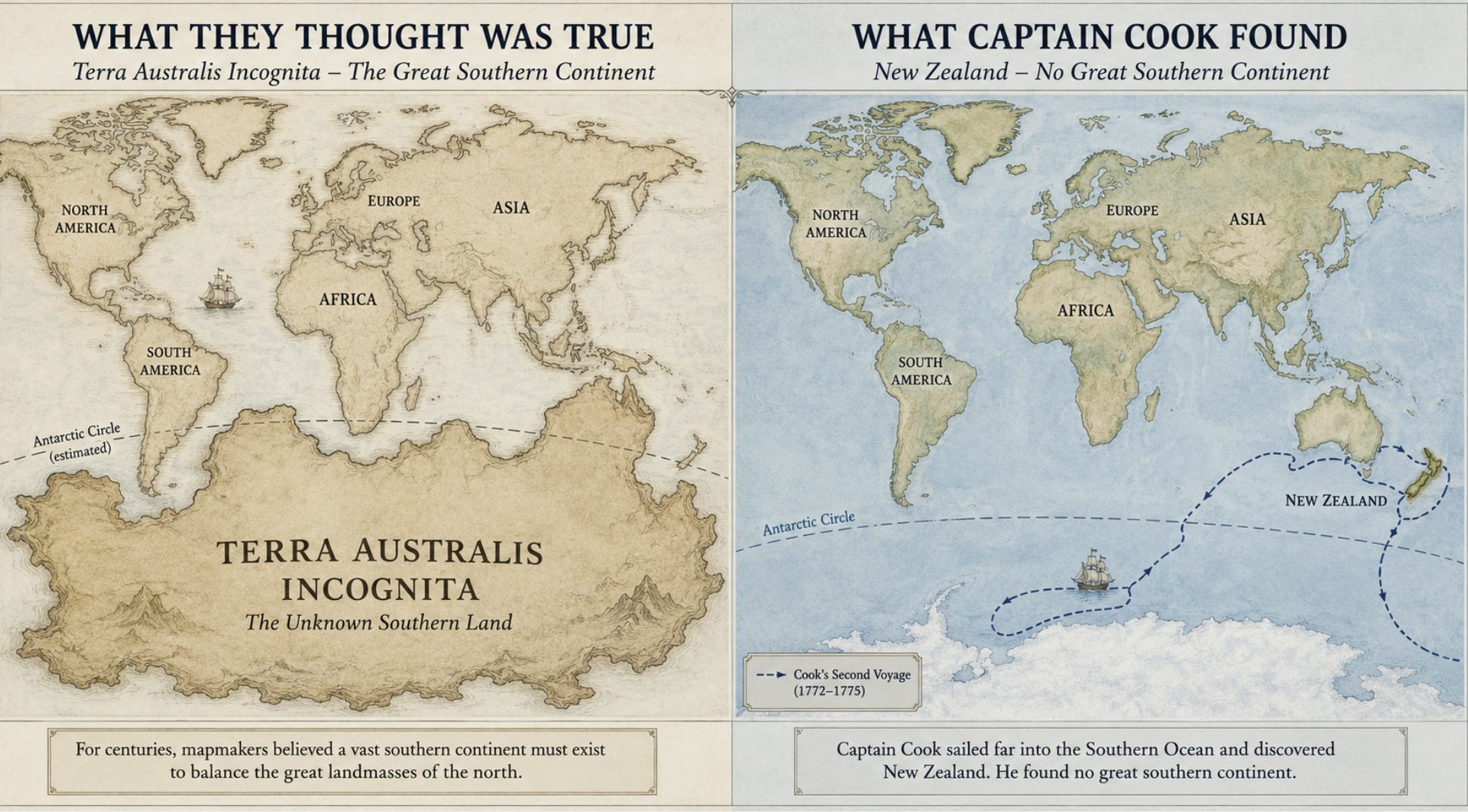
Imagine if New Zealand was that big, imagine how many Lord of the Rings movies we could shoot! Imagine the sheep!

We would be 5 times the size of Russia. We would be the superpower of the world! We could visit America and talk about how small Texas is.
Alas, twas not to be.
Of course it is funny in hindsight to think that people believed that there was a great southern continent.
But if you look hard enough, out there in the world there is all sorts of this going on.
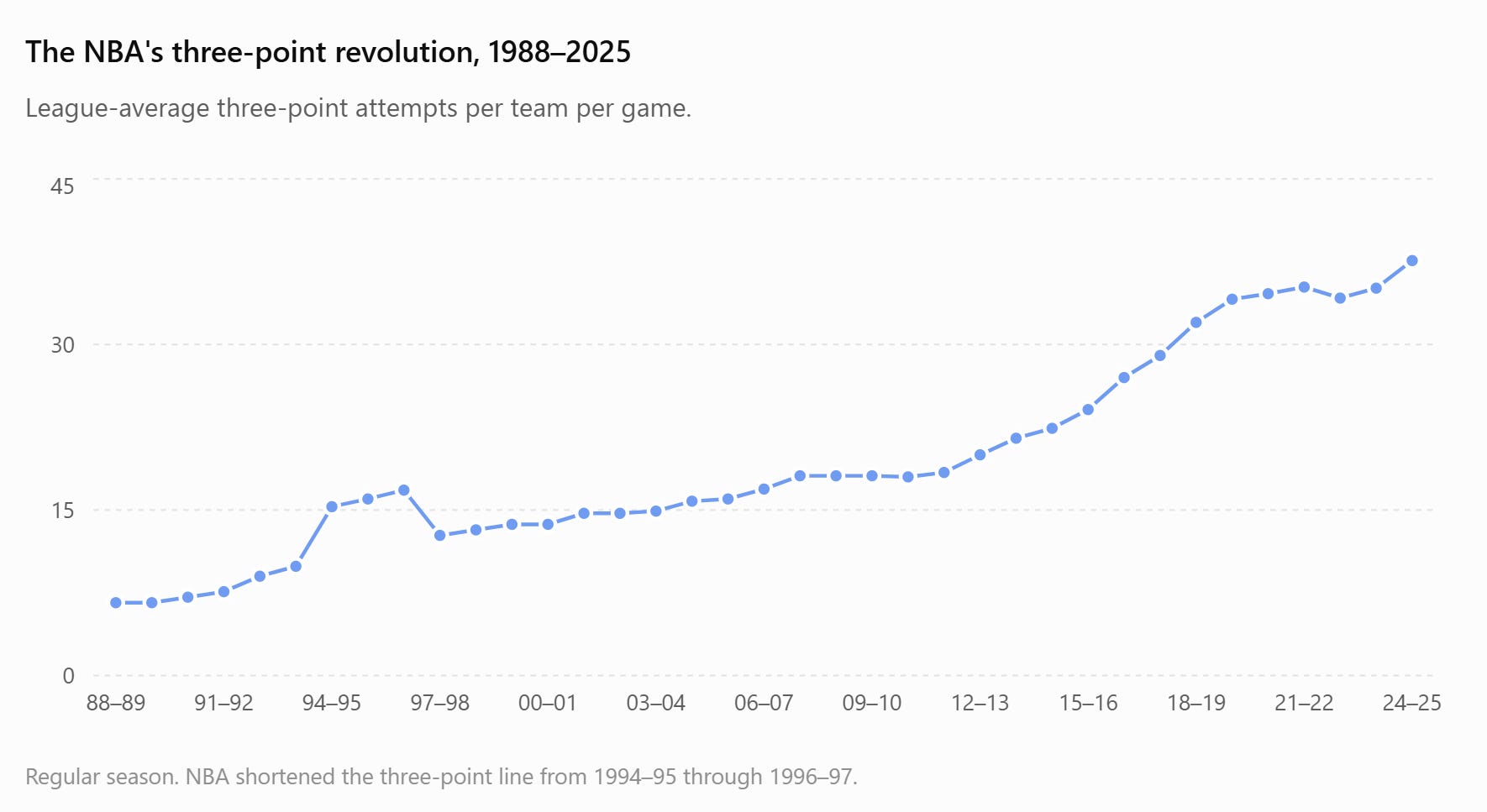
Let’s look at basketball and at how many three point attempts since 1988.
Let me get out a pen and put in the “Great Southern Continent” effect that was going on.
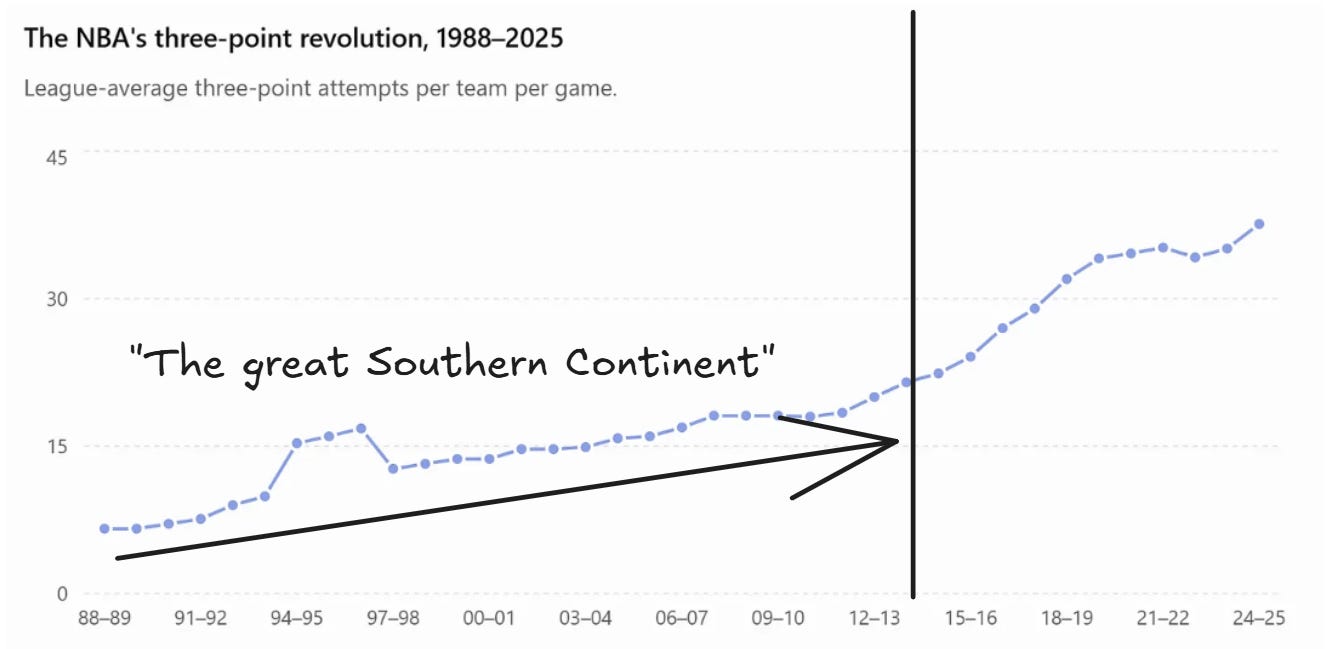
From 1988 to 2013 three pointers moved up a tiny bit, then all of a sudden they spiked up.
What’s going on here?
Let’s put the dots where Golden State won the championship.
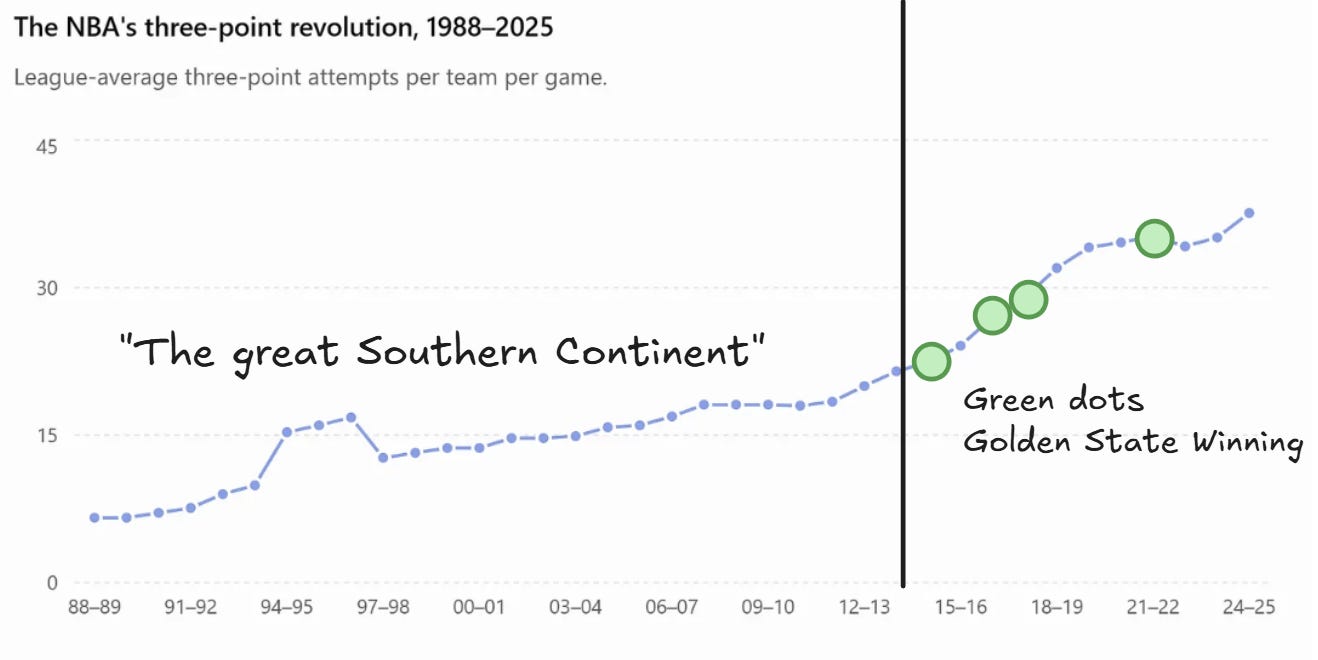
In other words, Steph Curry and the Golden State Warriors started winning by shooting heaps of 3s. Then everyone else saw what they were doing and the entire league copied them.
Steph Curry is the Captain James Cook of basketball.
The NBA has gone from shooting 6.6 three pointers a game to 37.6 over the space of 35 years!
The wild thing about this insane increase? Lets look at the accuracy graph.
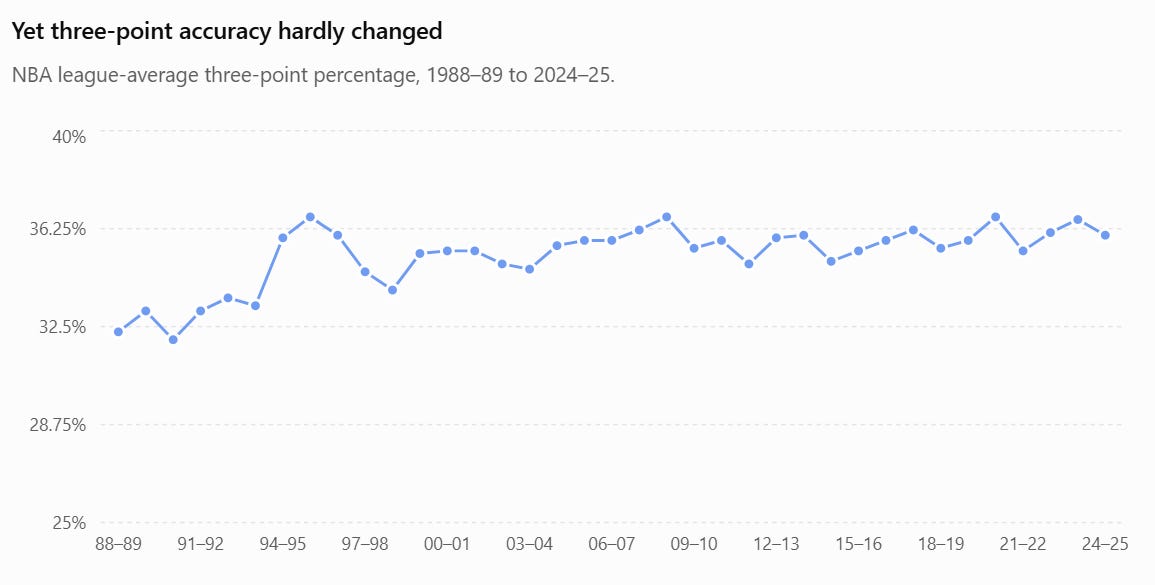
It’s barely changed!
Let’s put cumulative attempts in here.
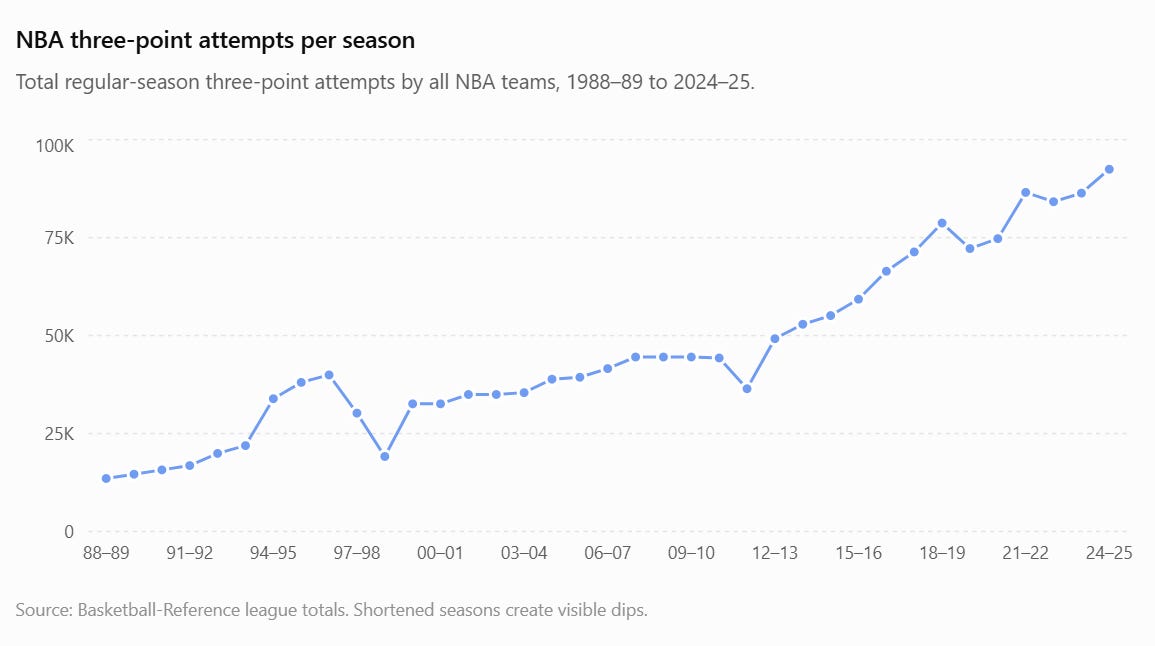
From 13,000 3 pointers in 1988 to nearly 100,000 in 2025 and the accuracy hasn’t changed!!
Guess what happens when you shoot way more three pointers and your accuracy doesn’t change? You score way more points and you win way more games.
That single graph on it’s own was worth billions of dollars to the Golden State Warriors, it was hiding in plain sight.
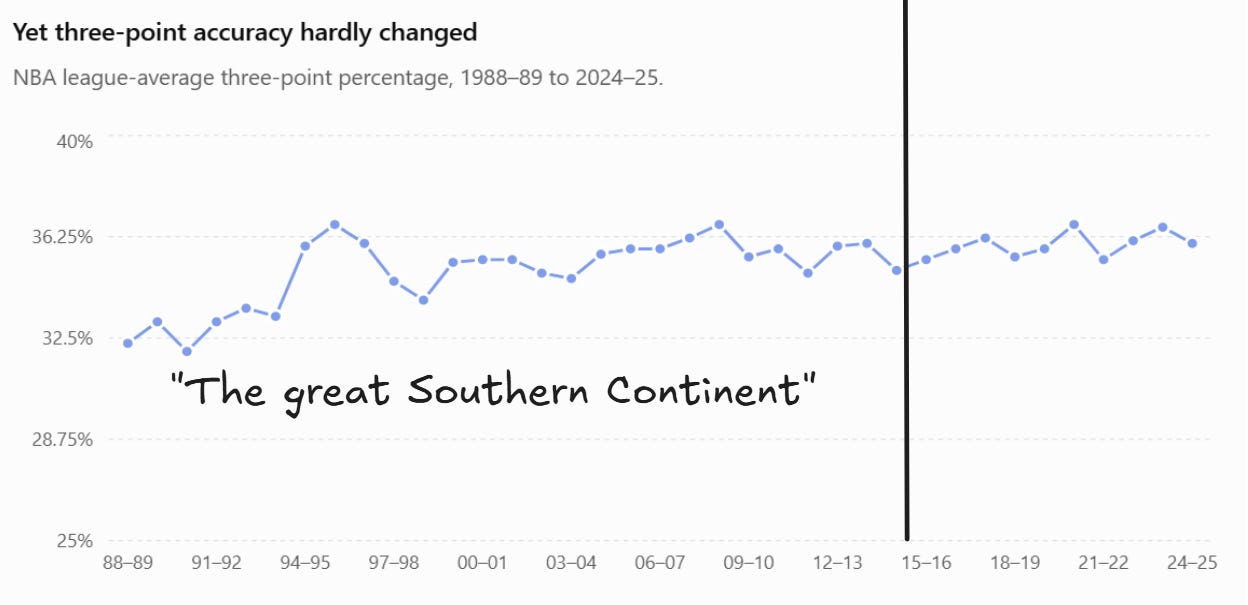
This is a time period of 30 years.
Think of the analysts
Think of the PowerBI charts
Think of the strategies
Think of the theories
Think of all the work that went into analysing the game of basketball and it turns out you should have shot more threes the entire time.
What does this reveal? What is my point?
My point is that, we can spend a lot of time doing a lot of work and meanwhile we miss the truth. We miss the fact that New Zealand is tiny and that we should have attempted way more 3 pointers than we were for 30 years.
Imagine I sent you in a time machine back to 1995 and I armed you with ChatGPT. Just like now you could ask any question that you can think of:
Why are we losing away games?
Which players should we buy next year in the draft?
Why do we give up so many points in the third quarter?
What is the best lineup?
You get the point, you could ask any question you like, yet you aren’t guaranteed to ask the one that matters, “why don’t we shoot 40 3-pointers a game?” Also, even if ChatGPT said that, with everyone else shooting only 10 3’s a game, you would think that ChatGPT was broken. It’s the great southern continent effect, again! You don’t believe the truth of the answer.
This is a paradox. We have a smart tool, but we don’t actually know the truth about a huge number of things that we are doing. This to me goes deeper than someone having judgement, or building ‘taste’ or all that other stuff that LinkedIn froths on, because I’m sure 30 years of NBA analysts had taste and judgement and yet it took a team to play differently to make everyone see the game differently.
Lets bring this back to a bunch of normal business situations
What exactly is correct in marketing?
Why is your customer retention low?
Is your strategy correct?
Is your product fundamentally broken?
You see in all of these, if you type them into ChatGPT you are going to get some ‘consensus answer’ and yet as we can see, consensus is often wrong and the truth of the matter could be much deeper or much more simpler than we expect.
As a result when you see this, you see a simple chatbox with an answer.

I’m starting to view it as a tree and it’s a tree that is rife with the ability to make a mistake and ripe with the ability for you to miss the point of the problem you are solving.
It’s a tree that gives you an illusion of something, but it might not actually be right.
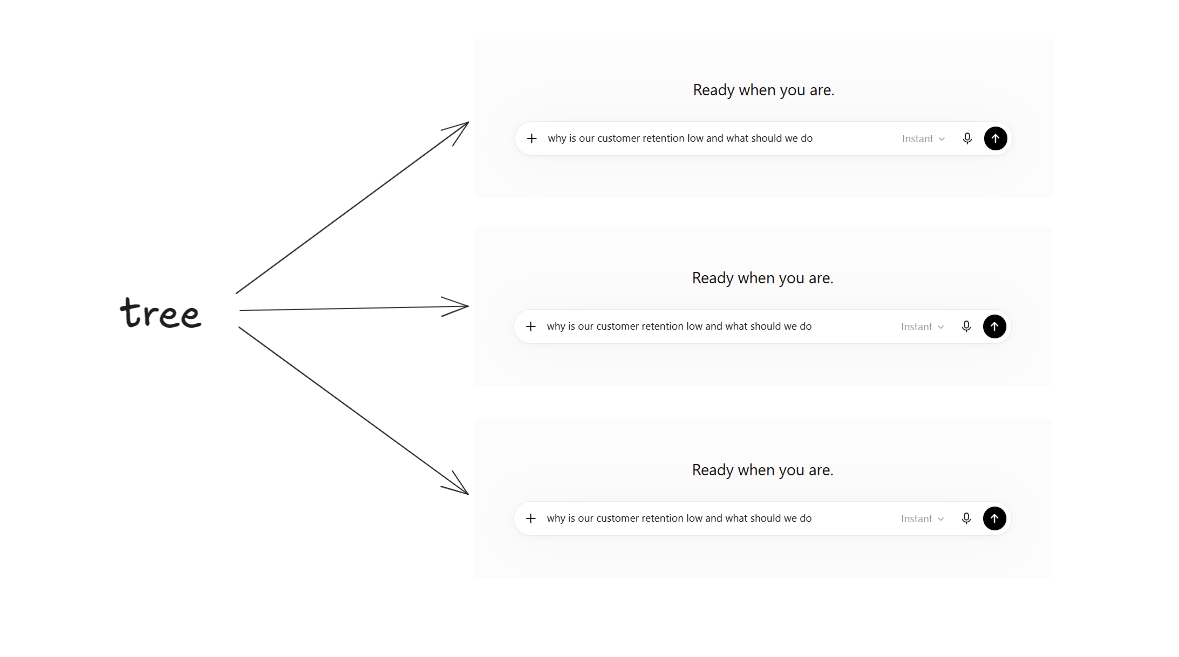
Actually, let me go further. This is such a prolific problem that every single company we roll out an AI system for faces it.
It’s a fundamental law of generative technologies. We can now go deep or on tangents unlike ever before.
Now this is the part where I should propose a grand and elegant solution but no, this is why I am writing the essay, I’m trying to figure this out.
I think I’m trying to articulate an important facet I am learning about “intelligence”. We usually think of intelligence as knowing answers, but in a sufficiently complicated system (which most businesses are) there are almost infinite questions and decision trees that you can branch.
But then, perhaps intelligence is partly the ability to work out where to search, certainly James Cook had that correct and the Golden State Warriors may have accidentally searched in the right area by having a gifted three point shooter.
So now we turn to the key question.
What is your three-pointer?
Marketing is one that I think is not solved
Sales is the next one, if you are measuring activity etc, what if everything you are measuring is wrong? David Ogilvy, talked about only getting a new customer every 2 years because if he did that then he could service his existing ones well. What would that look like in your business? What would optimal retention service look like?
Maybe you don’t know why customers actually buy your product?
Maybe your dashboards don’t matter? Maybe they just make you feel good?
What if what you are measuring is wrong?
Again I’m not going to divinely promise that I know the answer to the question I am posing but I do think it starts by questioning assumptions that you have long held or maybe assumptions that are implicit and that you don’t even know you are making. Just like a scientist, you are trying to get closer to the truth of whatever you are currently doing.
One simple trick I do is that if I am learning a subject, I will go and buy a bunch of books on that subject.
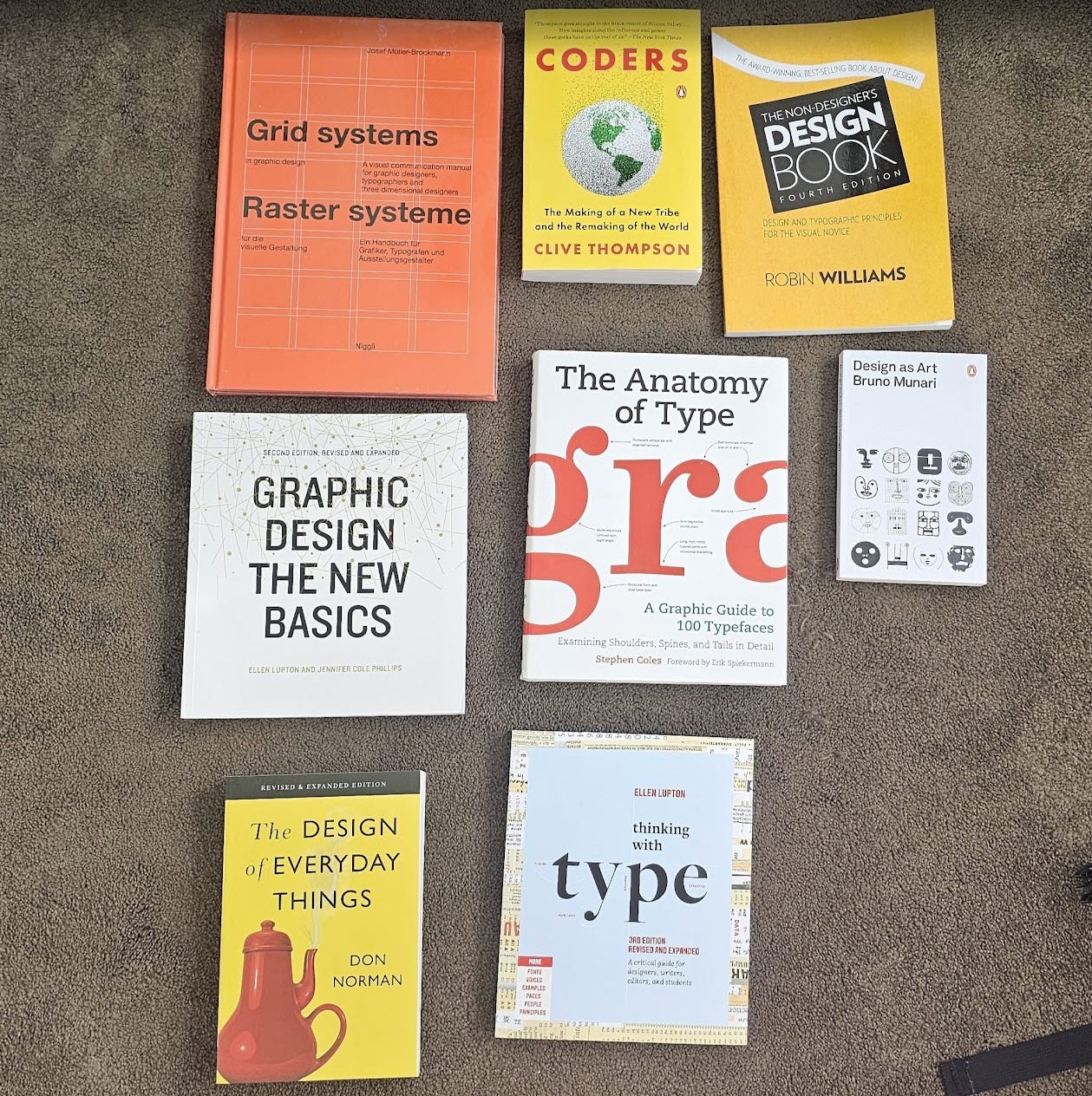
I do this every time I want to learn something new. When I was learning how to do sales, I read these books.
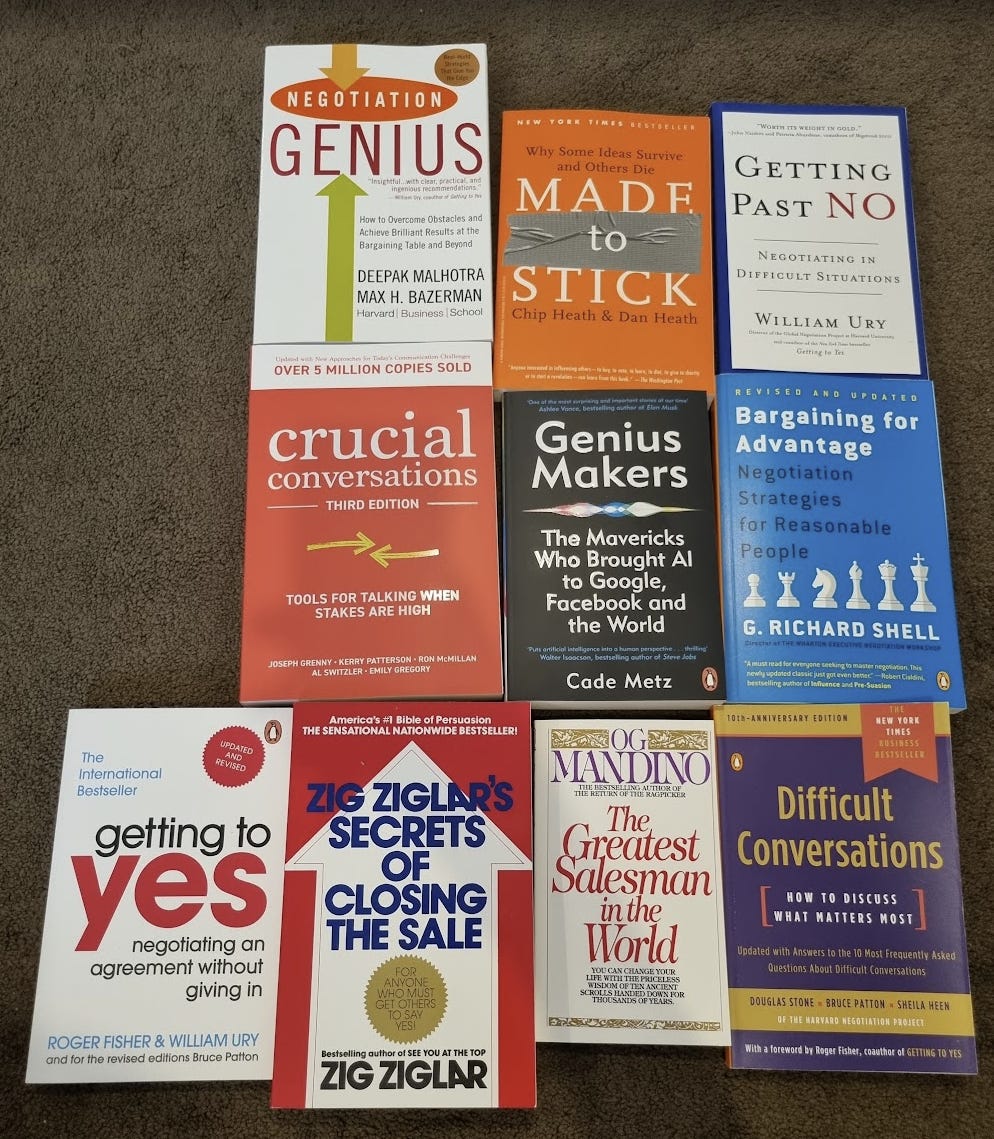
The same thing with writing, the same thing with any topic. This is one way that you can get closer to the ‘truth’ in the sense that you have more frames of reference and mental models to question something.
One of my takeaways from this essay is that you should commit to more searching of a domain rather than just diving into the first answer that is suggested.
I don’t think you can shortcut reading on this as it takes time for your brain to absorb a domain and just having ChatGPT spit answers at you isn’t the same.
This does trickle down into how you use AI as well.
Instead of diving straight into a prompt, get it to list different frameworks/strategies/literature/approaches to the problem
Get it to research open source repos/white papers
At least this will help you to widen your search horizon and not get locked into one branch.
I also think it fundamentally changes how you should hire and it has changed how we are hiring at Cub.
Instead of testing whether someone knows a particular framework off by heart, we give them a messy real world problem, and we encourage them to use AI and see how they approach it.
What I am particularly interested is their first prompt and their problem solving approach. I’m watching whether they go wide and search or do they just accept the first thing and go down the first branch. Just a simple test like that can let you know how much someone has worked with AI as the more you work with it, the more you realise you need to explore breadth first before you go deep.
The point of this essay is that we now have a tool that allows us to question things and that we should start by fundamentally questioning things that we take for granted. I don’t think one Substack article can do this topic justice.
As a result to go deeper on this topic, I’ve made two resources (at the end of this essay)
The first is a prompt you can put into ChatGPT that will help you with searching domains
The second is a thorough workbook with exercises, it’s 26 pages and it’s filled with questions and example exercises. The reason for that is that I don’t think the conclusion/outcome of this essay is easy to follow in practice, but takes hard work. I also outline how I approach things when I’m dealing in new domains and solving novel analytical problems that require depth and don’t have an ‘easy’ answer.
So as the title of the essay says, what is your three-pointer?
Book Club
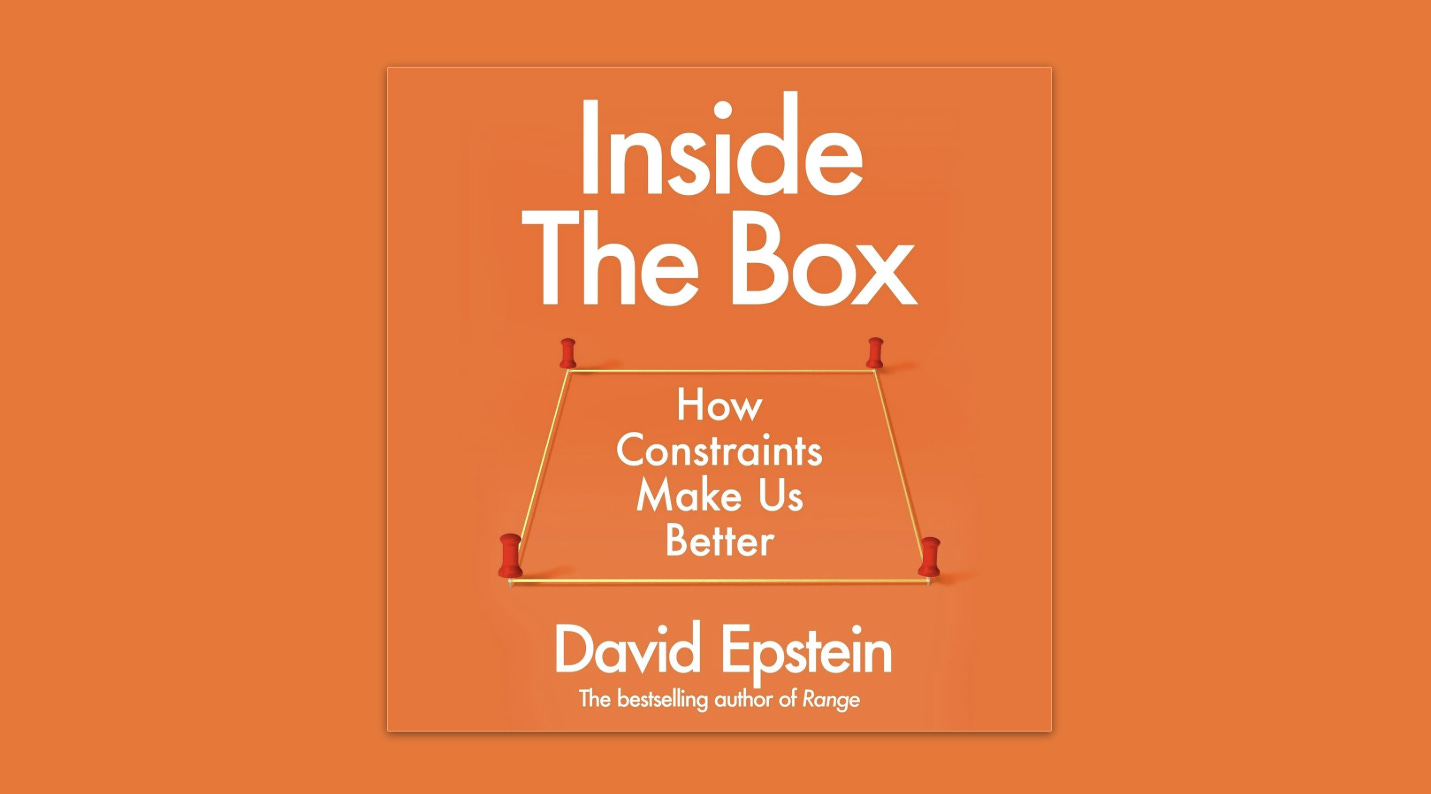
Inside The Box by David Epstein. This is an epic book. I think it pairs really nicely with the essay this work. He talks about how a company in the dotcom era had unlimited resources and they went bankrupt and yet on the other hand there is so many examples of people that have constraints that do well.
This is a really fitting essay for the age of AI and the thing it has challenged me on is putting constraints on my thinking as a forcing function. Maybe that is limiting what I can do in terms of time or maybe its limiting the budget of a project, David would suggest that all of these are great things.
He is the author of Range, which is one of my all time favourite books and so if you haven’t read that you definitely should.
View the book on Amazon here.
I’m an Amazon Affiliate, I make a commission if you buy the book.
Other Articles I Wrote This Week